
Searching Ward County Criminal Dockets
Begin with the court, not the name alone. In Ward County, felonies belong to the 143rd Judicial District Court and its District Clerk. Class A and B misdemeanors are different. Those, plus other county-level criminal cases, go to Ward County Court and the County Clerk. Fine-only Class C cases stay with the justice court or municipal court that issued them. Knowing this split matters. A solid search run in the wrong clerk's system comes back empty. It looks like no case exists.
re:SearchTX covers cases, filings, and hearings that participating offices supply, and the county-linked LGS system may surface County Clerk records. Neither one promises a complete set of local cases or documents. Work through these steps:
- Read the citation, notice, bond paper, or prior filing to identify the court.
- Search with the cause number and Ward County filter when one is known.
- If searching by name, try the full legal name and review court and case type.
- Open the result and compare filing dates, settings, and the listed court.
- Ask the proper clerk for the current docket or certified record when the result must be official.
Ward Felony Docket Route
The Ward County Clerk expressly excludes felonies, and that boundary trips up plenty of searches. A felony filed in Ward belongs to the District Clerk for the 143rd Judicial District Court. That court serves Loving, Reeves, and Ward counties. Anyone using a statewide tool should set the filter to Ward County as well as the court itself. The district reaches across three counties. The 143rd District Court profile names the court. It also posts schedules and standing orders, and the linked official page supplies this view of the court:
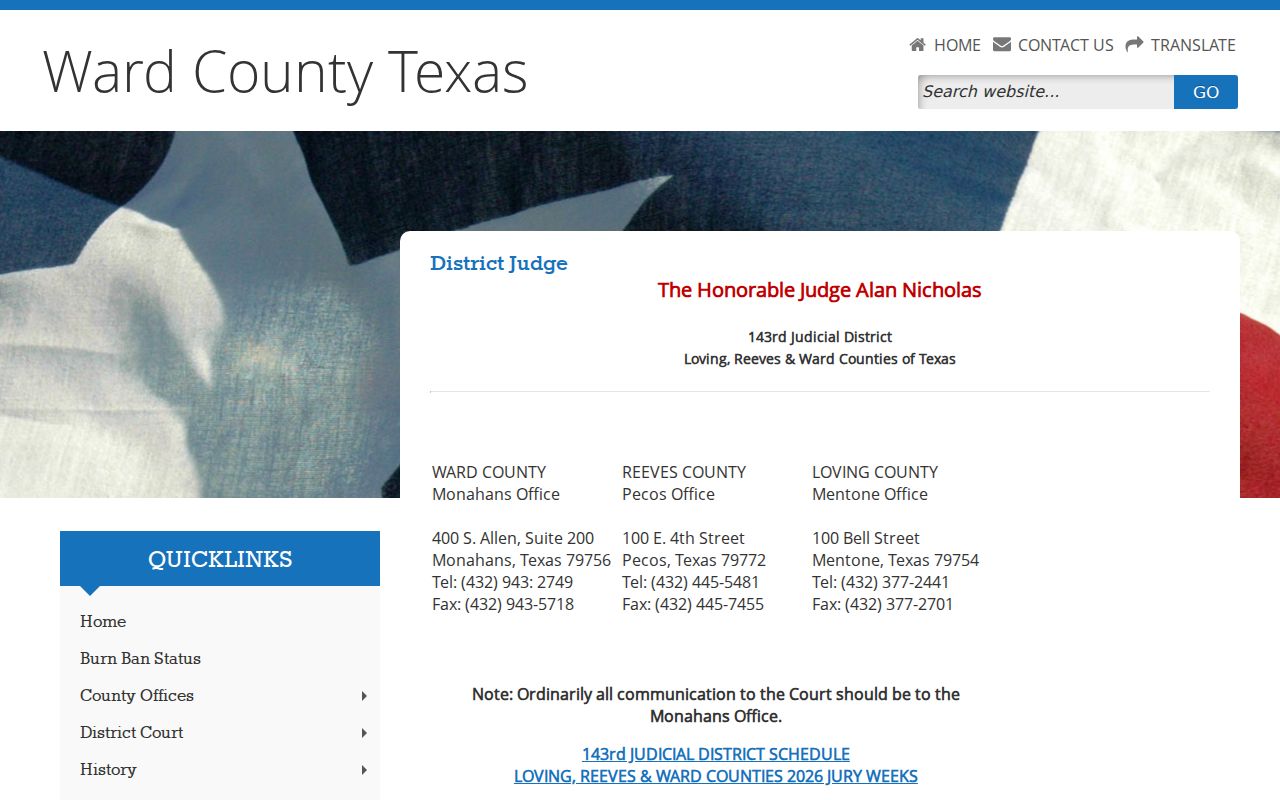
That listing names the court, but it is not a live criminal docket. For a case chronology or a document, call the District Clerk at 432-943-2751 or go to the Ward County Courthouse at 400 S Allen in Monahans. Filings reach the clerk through eFileTexas or U.S. mail, though filing a case and searching public records are two different tasks.
Inside a Ward County Criminal Docket
Read a docket result field by field. One short index line can confirm an event happened. The underlying paper may stay out of view. Write down the court, the cause number, the case type, and the date you checked the source. Then keep allegations, scheduled events, and actual rulings in separate mental piles.
| Cause number | The court's identifier for clerk requests; it may differ from a citation number. |
|---|---|
| Charge or case type | The official public description, not proof that an allegation is true. |
| Setting | An arraignment, pretrial, trial, or other event; a setting is not an outcome. |
| Docket entry | A dated filing or event notation that may link to a separate document. |
| Disposition | The court's wording for how a charge or case ended; preserve it exactly. |
| Access status | Public, paid, restricted, or available only from the clerk. |
"Motion filed" is a request, not a ruling granting it. "Trial setting" is only a scheduled date, never proof a trial took place. A bond entry covers procedure or release conditions, and it says nothing about guilt.
Ward Criminal Docket Custodians
Ward County keeps no single master record spanning every criminal level. The labels matter. A felony cause, a county misdemeanor, a JP citation, and a city case can each carry different identifiers and retrieval tools.
| Court level | Typical criminal work | Official contact |
|---|---|---|
| 143rd District Court | Felony cases and public grand-jury schedule dates | District Clerk, 432-943-2751 |
| Ward County Court | County criminal categories, including Class A/B jurisdiction | County Court number listed by OCA, 432-943-3209 |
| JP Precincts 1 & 4 | Class C and magistrate matters | 432-943-5060 or 432-943-7227 |
| JP Precincts 2 & 3 | Class C and magistrate matters | 432-943-7237 |
| Monahans Municipal Court | City ordinance and fine-only cases | 432-943-6361 |
GovRec and TrafficPayment handle limited citation tasks only. Neither replaces the issuing court's docket. For wider options, use the Ward County case lookup route.
How a Criminal Case Moves
A district criminal docket often opens with a complaint or indictment entry. From there it may list an arraignment, pretrial settings, motions, and a plea or trial. A judgment, sentence, dismissal, appeal, or post-judgment action may follow later. County and lower courts run on different paths. Treat this as a reading sequence. It does not guarantee that every case contains each event.
Docket flow: Charge Filed › Arraignment › Pretrial › Plea or Trial › Disposition › Sentencing
A reset simply moves an event to a new setting. It is not a dismissal. A plea is the accused person's formal answer, while a judgment is the court's formal adjudication, so check the signed order or judgment before describing any result.
Ward Criminal Grand Jury Dockets
The 143rd District Court sometimes posts a trial schedule listing grand-jury impanelment dates. That date gives calendar context and nothing more. Grand-jury evidence, witnesses, deliberations, and protected materials stay closed even when an impanelment date sits on a public schedule.
Calendar is not case proof. Do not infer an indictment, a named target, or a result from a grand-jury calendar line. Ask the District Clerk whether a public criminal case was filed and use only the public docket terminology returned.
Missing an expected felony case? Check the Ward filter, the spelling, the cause number, any filing lag, and the court. A restricted record can also hide a case. Absence never proves that no matter exists.
Keep three records straight. An impanelment schedule says when the grand jury is due to meet. An indictment, once filed and public, is a charging document. The criminal docket then tracks the public court events tied to that filed cause. No single one substitutes for the others. The public calendar reveals nothing about what happened in the confidential room.
Courts That Hold Criminal Dockets
The 143rd District Court serves as the general-jurisdiction trial court for Ward felony matters. Ward County Court keeps its own county-level criminal docket. The two JP offices hear lower-level cases tied to their precinct and issuing authority. Monahans Municipal Court holds city ordinance and fine-only matters.
Match the caption or issuing court printed on the document. Unclear? Call a clerk with the public case name, an approximate filing date, and any cause or citation number. The Ward County Courthouse houses both the District Clerk and the County Clerk. Justice and municipal courts run their own counters. Mail may work for a defined request. Official district filings cannot go out by fax or email.
Ward Supervision Is Not Docket
Supervision after sentencing runs through the 143rd Community Supervision and Corrections Department, which handles appointments, forms, and payments. That is an administrative office. Its Ward location is 400 S Allen, Suite 104, Monahans. The listed phone is 432-943-2851. None of those records can substitute for the judgment, plea, sentence entry, or chronology that the originating Ward County court keeps in its docket.
- Community supervision
- Post-disposition oversight under court-ordered terms.
- Originating docket
- The court record showing the charge, plea, judgment, and later court actions.
- Disposition
- The court system's stated outcome for a case or charge.
Confirm what the judge actually ordered by reading the court docket first. CSCD can only speak to its own public administrative instructions, and treatment, health, or personal supervision details may be protected from release.
Sealed Dockets and Public Access
Texas treats many judicial records as public. Access still has limits. A sealing order, juvenile law, expunction, a redaction rule, or another statute can pull a case or document out of public view. re:SearchTX states plainly that it does not distribute sealed or protected information through the service.
Key rules:
Texas Rule 12 governs judicial-record requests and allows lawful restrictions.
Texas Family Code Chapter 58 sets juvenile-record confidentiality.
Code of Criminal Procedure Chapter 55A governs expunction and record visibility.
If a clerk denies access, ask two things. Does a public order or a redacted copy exist, and what authority controls the restriction? The Texas Public Information Act may reach administrative material, but it cannot be used to slip past Rule 12 or a sealing order.
Missing Ward Criminal Results
When a Ward County docket search comes back empty, the case may still exist. The clerk's office might not be tied into the online system. The name or number may have been keyed in differently. The matter may sit in another Ward court. Access to it may be restricted. A blank screen proves nothing. Try the cause number, confirm the court label, and write down the search date.
Skip the computer when you have to. Felonies live with the District Clerk, so call or visit that office. County Court criminal matters go through the County Clerk or the court number listed in the OCA directory. For a Class C matter, contact the JP or municipal clerk named on the ticket. Ask for the docket sheet, a specific public order, or a certified copy. Give enough detail to identify the file. This chain covers online, counter, phone, and mail access. It never mistakes a payment screen for an actual case record.
Make your request easy to fill. Name the court, the cause or citation number, the public case name, the rough date, and the exact item you want. Say whether you need to inspect the file. Get an electronic copy, a plain paper copy, or a certified copy. Without a cause number, ask if a lawful name search is offered and whether a search fee applies. Hold back private identifiers the clerk has not asked for. Note which office answered you and when. Later docket entries or an access ruling can change the result.